
The Ultimate Guide to the 2026 World Cup Group Stage Format
Get ready for the historic 2026 World Cup! Learn everything about the expanded 48-team group stage format, including tie-breakers and advancement rules.
48 countries. That’s the number of countries in Asia, as well as the total number of nations that will be competing in the FIFA World Cup 2026™. This is a 50 percent increase over the past seven tournaments, making this the largest World Cup ever. That not only means that there will be more stadiums than ever hosting games, but the format itself has undergone some changes.
With that in mind, we put together this guide to the Group Stage, where all 48 nations will play three games before the knockout rounds begin. To watch English-language broadcasts of the FIFA World Cup 2026™ on FOX and FS1 with Sling, use the link below to subscribe to Sling Select with FS1 and, in designated markets, FOX.
The New Group Stage Structure
https://youtu.be/aGfDPf5jnb8?si=QDiQjes5e-YOUXZ1
With the historic expansion of the FIFA World Cup 2026™, there are now four more Groups than in past World Cups. Groups are labeled by letter (this year, A through L) and there are four teams in each group. The three host nations – the U.S., Canada, and Mexico – were pre-allocated into specific groups for scheduling purposes: Mexico is in Group A, Canada is in Group B, and the United States is in Group D.
Like past World Cups, FIFA World Cup 2026™ will follow a round-robin format: Every team will play the other teams in their group, a total of three games each. Here’s a look at Groups A through L:
- Group A: Mexico, South Africa, South Korea, and Czechia.
- Group B: Canada, Bosnia and Herzegovina, Qatar, and Switzerland.
- Group C: Brazil, Morocco, Haiti, and Scotland.
- Group D: United States, Paraguay, Australia, and Türkiye.
- Group E: Germany, Curaçao, Ivory Coast, and Ecuador.
- Group F: Netherlands, Japan, Sweden, and Tunisia.
- Group G: Belgium, Egypt, Iran, and New Zealand.
- Group H: Spain, Cape Verde, Saudi Arabia, and Uruguay.
- Group I: France, Senegal, Iraq, and Norway.
- Group J: Argentina, Algeria, Austria, and Jordan.
- Group K: Portugal, DR Congo, Uzbekistan, and Colombia.
- Group L: England, Croatia, Ghana, and Panama.
The Group Stage will run from the opening match on June 11, 2026 – Mexico vs. South Africa – through June 27. All told, 72 of the tournament’s 104 matches take place in the Group Stage. To a significant portion of the world’s 8.3 billion people, this is the most exciting two weeks on the sports calendar (sorry, Olympics).
Advancement to the Knockout Stage
https://youtu.be/CFI3dDLpHlk?si=w9cccItZNkhbdxkj
At the conclusion of the Group Stage, the two teams with the most points in their group will advance to the newly-created Round of 32. During the Group Stage, teams will be awarded 3 points for a win, 1 point for a tie, and no points for a loss.
If you’re a math wiz, you’ve already deduced that with two teams advancing from the 12 Groups, that’s only 24 teams. The rest of the Round of 32 will be filled out by the eight third-placed teams with the most points across all groups. This incentivizes teams to give their all, even if they’ve been eliminated from the top two spots in their Group.
Tie-Breaking Criteria
It’s not at all uncommon for teams to end up tied in points at the end of the Group Stage. Here’s a hypothetical involving Group F that illustrates how FIFA™ would break the tie:
Results
- Japan 1 - 1 Sweden
- Japan 0 - 2 Netherlands (Japan loses)
- Sweden 0 - 2 Netherlands (Sweden loses)
- Japan 1 - 0 Tunisia (Japan wins)
- Sweden 1 - 0 Tunisia (Sweden wins)
In this instance, both Japan and Sweden finished with 4 points (1 win, 1 draw, 1 loss). Here is how tournament officials would apply the official tie-breaking criteria in order:
- Base Ranking (Points): Both Japan and Sweden finish with 4 points (1 win, 1 draw, 1 loss).
- Tie-Breaker 1 (Head-to-head points): Because Japan and Sweden played each other to a draw, they earned 1 point against each other, remaining tied.
- Tie-Breaker 2 (Head-to-head goal difference): Their 1-1 draw results in a 0 head-to-head goal difference for both teams.
- Tie-Breaker 3 (Head-to-head goals scored): Both teams scored exactly 1 goal against each other in their direct matchup.
- Tie-Breaker 4 (Overall goal difference): Both teams scored a total of 2 goals and conceded 3 goals across all of their group matches, giving both an identical overall goal difference of -1.
- Tie-Breaker 5 (Overall goals scored): Both teams scored exactly 2 goals in total during the group stage.
- Tie-Breaker 6 (Fair play score): Japan and Sweden would need to have accumulated the exact same disciplinary records during the tournament to remain tied. For example, if both teams received exactly three yellow cards (each resulting in a -1 point deduction) and zero red cards, they would both have an identical fair play score of -3.
The Final Resolution: Having exhausted all on-field statistics and disciplinary metrics, FIFA would be forced to invoke Tie-Breaker No. 7: the team's position in the most recent FIFA Men's World Ranking. Whichever of the two nations held the higher global ranking going into the tournament would officially win the tie-breaker and claim the higher position in Group F. In this extremely unlikely scenario, Japan would advance out of Group F, because they’re currently ranked higher (18th) than Sweden (38th).
Is Four Better Than Three?
An interesting side note in the tournament’s expansion is that when it was originally approved in 2017, FIFA was planning to change the format to 16 groups of three teams. The benefit of this would have been that it would have kept the total number of matches at 80, thereby allowing the tournament to be completed within its traditional 32-day window. It also would have kept the total number of matches played by any team advancing to the Final at seven.
But there was a big problem: Collusion. Because one team would always be idle during the final matchday in a three-team group, the two teams playing the last game would know the result they both needed to advance. This created a scenario where they could mutually agree to play for a specific score (like a draw) that would eliminate the idle third team.
FIFA then proposed eliminating any draws with a penalty shootout. But this too could harbor collusion, as teams could intentionally miss their PKs to eliminate a rival. In the end, FIFA decided more games (and more revenue) would be better than the integrity concerns raised by the three-team format, and officially switched back to four-team groups in March 2023.
How to Watch FIFA World Cup 2026™ Live on FOX and FS1 with Sling
https://youtu.be/XSPvVt3xHAw?si=k-OgrQ476pGHyKnk
English-language coverage of the FIFA World Cup 2026™ will be exclusive to FOX and FS1. However, Team USA will play only on FOX.
FOX is available to Sling Select, Sling Blue, or Sling Orange + Blue subscribers in the markets listed below:
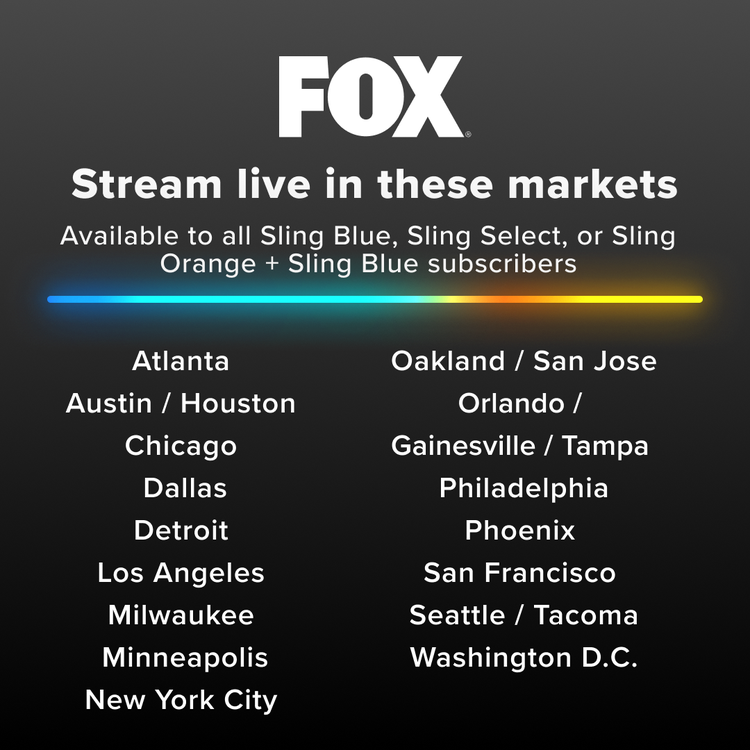
If you live in one of these markets, you can watch every game of the FIFA World Cup 2026™ with a subscription to Sling Select, Sling Blue, or Sling Orange + Blue.
Here are the Sling services with FS1:
- Sling Select (Best Value)
- Sling Blue (More Variety)
- Sling Orange + Blue (Most Channels)
For complete details on how to watch FIFA World Cup 2026™ on FOX and FS1 with Sling, follow the link.
Click the link below to subscribe to Sling Select with FS1 and, in designated markets, FOX!